
Perspectives
Figure: from BMW robot trials to a manufacturing platform
Figure combines automotive robot trials with new hardware, manufacturing systems and learning models as it develops its humanoid platform.
Published

A completed trial in Spartanburg
Figure’s humanoid robot completed a several-week trial at BMW’s Spartanburg plant in South Carolina, in the United States, during 2024. Figure 02 placed sheet-metal parts into fixtures for subsequent chassis assembly. The task required coordinated handling and precise placement within an existing production environment. BMW production board member Milan Nedeljković described the early operation as a way to identify possible manufacturing applications and accompany the technology towards industrial use.
Figure founder and chief executive Brett Adcock presented the second-generation robot as a technical advance in autonomous manipulation. BMW identified improvements in computing, cameras, microphones, battery performance and hands compared with its predecessor. At the August 2024 announcement, however, BMW had no Figure robots remaining at Spartanburg and no definite timetable for their return. The companies intended to continue collecting data and training the system for future applications. The completed trial therefore preceded the later deployment programme and subsequent robot generations.

Helix begins with upper-body control
Figure introduced Helix on 20 February 2025 as a vision-language-action model connecting camera observations and language instructions to robot movement. Its initial architecture separated two processes. System 2 handled scene understanding and language at approximately 7–9 Hz, while System 1 generated upper-body control at 200 Hz. Figure specified a seven-billion-parameter model for the first process and an 80-million-parameter visuomotor transformer for the second, running on separate embedded graphics processors.
The company trained the system with approximately 500 hours of teleoperated demonstrations from multiple robots and operators. Its described action space covered 35 degrees of freedom, including the fingers, wrists, torso and head. Helix’s demonstration tasks included putting away groceries, operating drawers and handing objects between two robots using the same model weights. These were Figure’s reported research capabilities. The initial system concentrated on the upper body; the company’s later full-body architecture added a separate control layer and a different human-motion training dataset.
BotQ and the manufacturing process
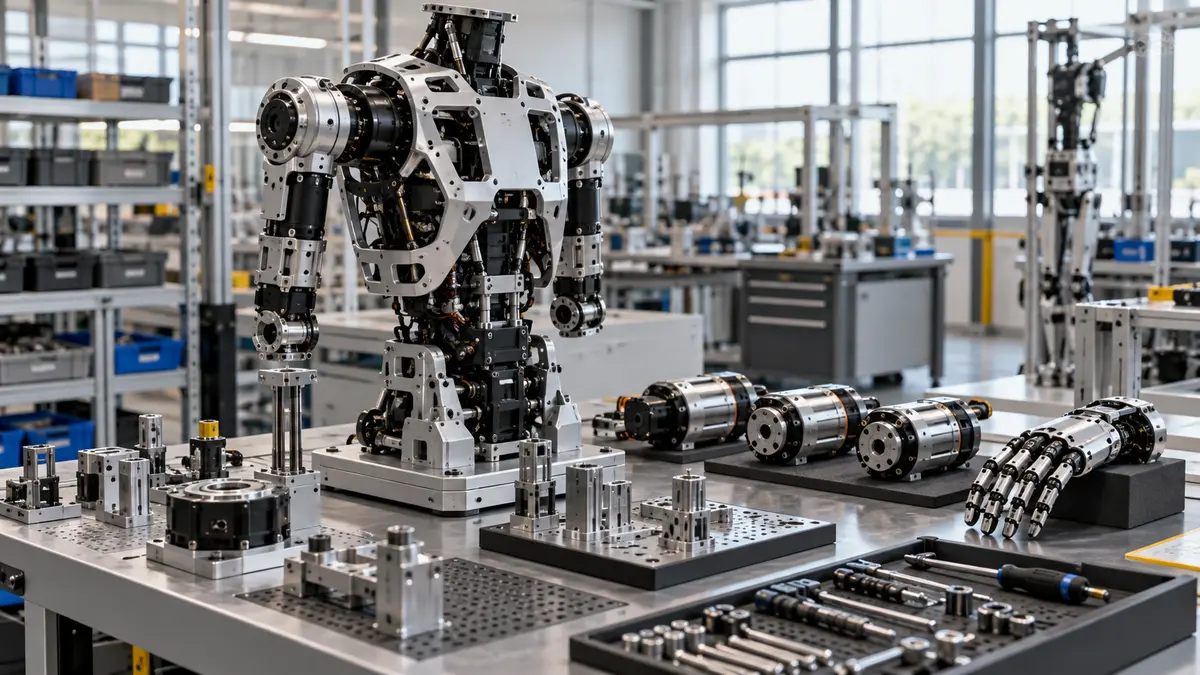
On 15 March 2025, Figure announced BotQ, a manufacturing facility whose first-generation line was intended to support up to 12,000 humanoid robots annually. The company brought actuator, hand, battery and final assembly in-house while using external suppliers for individual components. Manufacturing engineers divided assembly into substations, selected joining tools and designed fixtures and tests. Figure also established reliability work involving accelerated lifecycle testing and failure analysis.
The production architecture moved towards injection moulding, die-casting, metal injection moulding and stamping. Figure contrasted these tooled processes with the extensive machining used for its earlier prototype. Its software infrastructure combined product lifecycle management, enterprise resource planning, warehouse management and an internally developed manufacturing execution system. Component genealogy and test records formed part of the production database. Automated gearbox-grease dispensing and battery-cell scanning were examples of selected factory operations. The annual figure described planned line capability, while the company’s proposal to use humanoids in its own assembly process was a further automation plan.

Learning to walk in simulation
Figure described a reinforcement-learning walking controller on 25 March 2025. Thousands of virtual robots trained in a physics simulator with varied physical properties and operating conditions. The training rewarded resemblance to human walking reference trajectories, including heel strikes, toe-offs and coordinated arm movement. Other reward terms addressed velocity tracking, power consumption and responses to disturbances. The simulated scenarios included changes in terrain and actuator dynamics.
Domain randomization exposed the policy to different robot characteristics, while high-frequency torque feedback addressed differences between the simulated system and physical hardware. Figure reported transfer to real Figure 02 robots without additional fine-tuning and described a ten-robot demonstration using the same policy. The programme concerned locomotion, including balance and responses to pushes or changes in friction. Its simulated experience was distinct from accumulated physical operating hours on an automotive line.

Package handling and matched evaluations
By 7 June 2025, Figure’s Helix logistics work covered rigid boxes, plastic bags and flat envelopes. The model used stereo vision, a memory of recent images, a history of robot states and force feedback. These inputs supported tasks such as rotating parcels so labels faced a scanner, adjusting grasps and flattening wrinkled packaging. The company also described a handover behaviour learned from additional demonstrations of people reaching for a package.
Figure’s controlled comparison of models trained with approximately ten and sixty hours of demonstrations used the same architecture and training settings. Average handling time changed from about 6.84 to 4.31 seconds per package, while successful barcode orientation increased from 88.2% to 94.4%. A separate model with a larger decoder head produced another speed-and-accuracy result. The matched comparison relates specifically to the company’s package-handling evaluation, including the amount of training data. It does not establish a plant-wide throughput or an independently measured result for every logistics task.

A battery integrated into the robot
Figure’s battery announcement on 17 July 2025 introduced a 2.3 kWh pack for Figure 03. The company designed and manufactured the system in-house at BotQ. Unlike its first-generation external battery arrangement, the newer pack fitted into the torso and served as a structural component. Its enclosure combined stamped steel, die-cast aluminium and structural adhesives. Cooling components were integrated into the casting, with active cooling supporting the stated 2 kW charging system.
The battery-management system monitored conditions including temperature, charge and discharge. Figure also described protections at the cell, interconnect and pack levels, with features intended to limit propagation after a cell failure. Manufacturing used tooled processes and the same production-management infrastructure supporting BotQ’s other assemblies. Figure associated the pack with a five-hour runtime claim, but that specification was separate from the operational hours subsequently reported at BMW. The pack’s energy rating, charging power and proposed operating duration describe different characteristics of the robot’s power system.

Capital for manufacturing and learning
Figure announced more than $1 billion in committed capital through its Series C round on 16 September 2025, at a post-money valuation of $39 billion. Parkway Venture Capital led the round. Named participants included Brookfield Asset Management, NVIDIA, Macquarie Capital, Intel Capital, Align Ventures, Tamarack Global, LG Technology Ventures, Salesforce, T-Mobile Ventures and Qualcomm Ventures.
The intended uses covered expansion of BotQ manufacturing, deployments in commercial and household settings, graphics-processing infrastructure for training and simulation, and collection of human video and other sensory data. Figure connected these activities with further development of Helix. The planned computing infrastructure would support models for perception, reasoning and control. The financing announcement described capital commitments and a valuation attached to that round. Those measures were separate from operating revenue, manufacturing output and the value of customer orders.

Human video and Project Go-Big
On 18 September 2025, Figure introduced Project Go-Big, a programme to collect human-perspective video for humanoid pretraining. A partnership with Brookfield provided access to varied residential and commercial environments. Figure said collection had begun in Brookfield locations. The property portfolio offered potential settings for gathering data; its size did not represent robot orders or a fleet already installed in those buildings.
Figure reported an initial navigation result trained using human video without robot demonstrations for that task. Language instructions specified destinations while visual observations informed movement commands. The company described a Helix network producing both manipulation and navigation outputs, extending earlier work focused on upper-body tasks. Human-perspective recordings supplied examples of routes through clutter and movement around objects. This was a dated research result within the data-collection programme. It differed from the teleoperated robot demonstrations used for the original Helix and from the later motion dataset supporting full-body control.

Figure 03 changes the sensing hardware
Figure introduced its third-generation humanoid on 9 October 2025 with redesigned hands and sensing equipment. Palm-mounted cameras provided close-range views when objects were obscured from the head cameras. Softer fingertips increased contact area, while embedded tactile sensors supplied information about contact forces. The company designed these inputs to support Helix’s grasping and manipulation. Figure reported twice the frame rate, one-quarter of the latency and a 60% wider field of view per camera for the new architecture.
The robot also gained removable, washable soft coverings, an updated audio system and inductive charging coils in its feet. Figure specified 2 kW wireless charging and 10 Gbps wireless data offload. It reported a mass reduction of 9% compared with Figure 02. Commercial users could choose more durable coverings and use side screens to identify individual robots. These features of the new generation combined sensing, interaction and servicing considerations.
BMW deployment results and hardware feedback
On 19 November 2025, Figure reported results from an eleven-month BMW programme. Its account included ten-hour weekday shifts, more than 90,000 parts loaded and over 1,250 operational hours, contributing to production of more than 30,000 X3 vehicles. The robot loaded sheet metal into fixtures before conventional industrial robots performed subsequent welding and handling. Its contribution was one production operation within the vehicle-manufacturing process.
Figure defined targets for cycle time, placement accuracy and human interventions. The specified 84-second overall cycle, 37-second loading phase, placement success above 99% and zero interventions per shift were requirements, rather than published achieved averages for every shift. Hardware experience also informed the successor: Figure identified the forearm as a prominent failure point and redesigned wrist electronics to remove a distribution board and dynamic cabling. Motor controllers would communicate directly with the main computer. Figure was beginning Figure 02 retirement when it published these results, incorporating the programme’s lessons into Figure 03.
Helix 02 adds whole-body coordination
Figure announced Helix 02 on 27 January 2026. The model extended control from the upper body to the legs and the rest of the robot. System 2 continued to interpret scenes and language, System 1 produced full-body joint targets at 200 Hz, and a new System 0 layer handled balance, contact and coordination at 1 kHz. Inputs included head and palm cameras, fingertip sensing and information about the robot’s own joint configuration.
Figure described System 0 as a ten-million-parameter network trained with more than 1,000 hours of retargeted human-motion data and reinforcement learning in over 200,000 parallel simulated environments. The simulations varied physical conditions so a learned controller could transfer to physical robots using the same network. The company’s demonstration combined walking and manipulation across a kitchen, including unloading and reloading a dishwasher. It described a four-minute sequence with 61 actions and no human intervention. That demonstration illustrated the research task and the interaction of the three control layers.
The production ramp reported in 2026
By 29 April 2026, Figure reported more than 350 third-generation robots delivered from BotQ and a demonstrated production cycle of one robot per hour, compared with an earlier rate of one per day. Its manufacturing execution software connected more than 150 workstations. The process included over fifty in-process inspection points and more than eighty functional checks before a completed robot was signed off.
Figure reported end-of-line first-pass yield above 80% for robots and a separate 99.3% first-pass yield on its battery line. The battery operation had shipped more than 500 packs, while actuator production exceeded 9,000 units across more than ten variants. Robots from the facility supported internal research, data collection and commercial-use development. Figure also described fleet-management, field-service and over-the-air update systems. The hourly cycle and component counts were production metrics with distinct scopes. They did not establish that every completed robot had been sold to a customer or that the earlier annual capacity target had already been achieved.
A different task at BMW
On 30 June 2026, Figure described the arrival of Figure 03 in Hall 52 at BMW’s Spartanburg plant. The new demonstration concerned sequencing: selecting and placing parts into the order required by assembly. It combined handling thin-walled components with pulling a large cart on caster wheels. Helix 02 coordinated the hands, arms, torso and feet while the robot stepped and changed position.
The company highlighted variation in the positions of carts, bins and individual parts. Its proposed workflow required visual corrections, changes in reach and foot placement, and adjustment to partially obscured objects. This task differed from the earlier Figure 02 sheet-metal loading operation. The June announcement identified a manufacturing-environment demonstration of the newer hardware and control model. It did not attach a new total of production hours, vehicles or completed commercial shifts to Figure 03 at the plant.
Index and the data pipeline
Figure introduced its Index data-collection initiative on 25 August 2026. The company reported 264,000 app downloads across 108 countries, more than 44,000 weekly active users and over sixteen million uploaded videos. Contributors recorded tasks in homes and workplaces, including logistics centres, restaurants, factories and offices. Figure said contributors had earned $15 million. These were company-reported participation, upload and payment figures at that date, rather than a count of accepted training examples.
The company’s ingestion process combined automated quality checks and human review. Similarity screening removed repeated material, while task quotas and content clusters adjusted the balance of the remaining data. Text captions were associated with episodes for subsequent use. Figure also committed to spending more than $1 billion on data and computing during the following twelve months. Its pipeline separated several operations:
- Filtering for technical and visual quality.
- Review for fraudulent submissions.
- Deduplication and rebalancing.
- Annotation of retained episodes.




Leave a comment