
Perspectives
Nitto’s Frankfort plan and advanced materials network
Nitto planned a Frankfort materials factory alongside changes elsewhere in its US network. Its engineering centres and product families span sealing, bonding, venting and surface protection.
Published

A Kentucky factory announcement
Nitto planned a new advanced-materials factory in Frankfort, Kentucky, with 220 full-time manufacturing jobs. The January 2025 announcement set spring 2025 as the expected start of full-scale production. The site at 120 Fortune Drive, in Franklin County’s Industrial Park 3, would add production space for a business serving automotive, aerospace and other industries. The project was described as a multimillion-dollar investment, without a precise investment figure in the announcement.
Other parts of Nitto’s United States network faced announced reductions: 56 jobs at a closing Jasper, Alabama, facility, 86 at a closing Chesapeake, Virginia, plant and 147 in Piqua, Ohio. These were reported plans, rather than a count of completed departures. Nitto then employed more than 27,000 people worldwide. The Frankfort plan and the other locations’ changes were covered by Manufacturing Dive.

Materials manufacturing across several decades
Nitto began in 1918 as Nitto Electric Industrial, making electrical insulating materials in Ohsaki, Tokyo, Japan. Its product history includes insulating varnishes in 1924, Black Tape in 1946 and anticorrosion tapes in 1949. Plastic tapes followed in 1951. In 1961, the company opened its first overseas office in New York and began producing both NITOFLON fluoroplastic products and SPV surface-protection vinyl sheets. Double-coated adhesive tape entered production in 1964.
Nitto Denko America was formed in 1968. Flexible printed circuits followed in 1973, while 1974 brought the formation of Nitto Belgium and the start of EPTSEALER sealing-material production. NITOHARD reinforcing and vibration-damping materials entered production in 1985. The company adopted the Nitto Denko name in 1988 and began making protective films for painted automotive surfaces in 1992. Its later development network included the Nitto Denko Asia Technical Center in Singapore, formed in 2008, and the inovas research and human-resource-development facility in Ibaraki, Osaka, opened in 2016.

Testing and customer development in Michigan
Nitto’s Novi, Michigan, operation provides in-house testing for noise, vibration and harshness, acoustics and sealing. Engineers and CAD designers work alongside sales staff. Customer work includes laboratory cooperation, sampling and computer-generated analytical studies. The operation’s company profile also lists personal customer visits and quotations among its services. The site is approximately twenty miles from Detroit, near automotive manufacturers’ plants and technical centres.
The business’s history records Nitto’s 2002 purchase of Acoustiseal, formerly part of Lear. Production at its St. Louis operation ended in 2008, with work transferred to Kansas City or competitors. A move to a new Novi facility followed in 2010. The associated automotive operation purchased land and a building in Mexico in 2011, opened a Riverside, Missouri, distribution centre in 2013 and invested in its Mexican facility in 2014. Its company name changed to Nitto Automotive in 2016 and Nitto, Inc. in 2020.

Lakewood’s manufacturing remit
The Lakewood, New Jersey, factory makes acoustic, structural and sealing materials for automotive applications. Its product remit also includes pressure-sensitive tapes used in the electrical, electronics, automotive and aerospace industries. Nitto’s factory profile identifies a distribution centre in Romulus, Michigan, alongside the Lakewood operation, and gives July 2009 as the listed company’s establishment date. The factory is at 1990 Rutgers University Boulevard, Lakewood, New Jersey 08701. Nitto describes its structural products as lightweight and intended to reduce road noise; those are the manufacturer’s descriptions of their purpose and performance.
Adhesion, films and porous structures
Nitto groups its technical capabilities into eight core technologies, developed from an earlier set of four over approximately twenty to thirty years. Adhesion covers both attaching and peeling, with applications ranging from automotive and construction materials to electronics. Thin-layer formation adds functions to a film. Nitto describes roll-to-roll processing as a particular capability: a film is unwound, processed and rewound. Its methods include precise organic coatings at submicron thicknesses and inorganic layers formed by sputtering or vapour deposition at the nanoscale.

Porous formation concerns the design of void structures, including structures used to soften vibration, sound or physical impact. Optical design addresses reflection, scattering and refraction, as well as transmission of selected wavelengths through films. Circuit formation combines conducting and insulating materials to form fine circuits, including circuits on metal substrates. Nitto also identifies separation among its core technologies. Its account distinguishes these capabilities from common supporting technologies such as simulation and measurement under actual operating conditions. These are group capabilities, without a claim that every process is installed at Frankfort.
A transport development network
Nitto’s current transport-business overview identifies five Automotive Technical Centers worldwide and sales offices in more than twenty-six countries. The centres provide product information and work on customer solutions involving newly developed functions. The transport portfolio extends beyond passenger cars to motorcycles, trains, heavy equipment, aircraft and marine applications. These are current company reference details, read in October 2026, separately from the January 2025 factory announcement.

Different materials for different vehicle locations
Nitto’s automotive application range includes double-coated tape for attaching dam rubber or vulcanised-rubber cushions. That construction combines rubber adhesive on one side with acrylic adhesive on the other. Wire-harness products include flexible acetate adhesive tapes, a halogen-free and PVC-free bundling tape, and PTFE tape for applications requiring heat resistance. The company also lists materials for attaching emblems and interior roof trim. Each is a particular material family associated with a particular part or assembly task.
For electronic control units, Nitto offers polyester-film labels for on-site printing in manufacturing and shipping-management systems. The listed DURATACK PT label family has a stated heat resistance of 150°C. Thermal-conduction sheets appear among the materials offered for ICs and power modules, while heat-conductive double-sided tape is listed for display-related attachments. This application range is part of the wider Nitto portfolio; the factory announcement did not assign this entire catalogue to Frankfort. The current product descriptions below likewise concern material families, rather than a verified list of that plant’s output.

Closed-cell and semi-closed-cell sealing foams
EPTSEALER No.6800
EPTSEALER No.6800 uses closed-cell EPDM rubber foam. Nitto offers the family for sealing joints in air-conditioner bodies, places requiring water resistance and sunroof attachment areas. Its specified sheet format is 1,000 millimetres wide and two metres long, with thicknesses from three to fifteen millimetres. Adhesive variants include EM-142 with butyl-rubber adhesive and No.681 with synthetic-resin adhesive. Nitto describes the butyl version as suited to rough surfaces, while the foam’s flexibility permits conformity to complicated clearances.
The No.6800 property table gives a specific gravity of 0.11, tensile strength of 35 newtons per square centimetre and elongation of 240%. Its listed compressive hardness is 2.5 newtons per square centimetre at 25% compression and 8.0 at 50%. Nitto labels the figures as observed sample values rather than guaranteed performance. The two compression levels therefore remain attached to their respective figures, rather than being presented as a single general hardness value.

EE-1000L
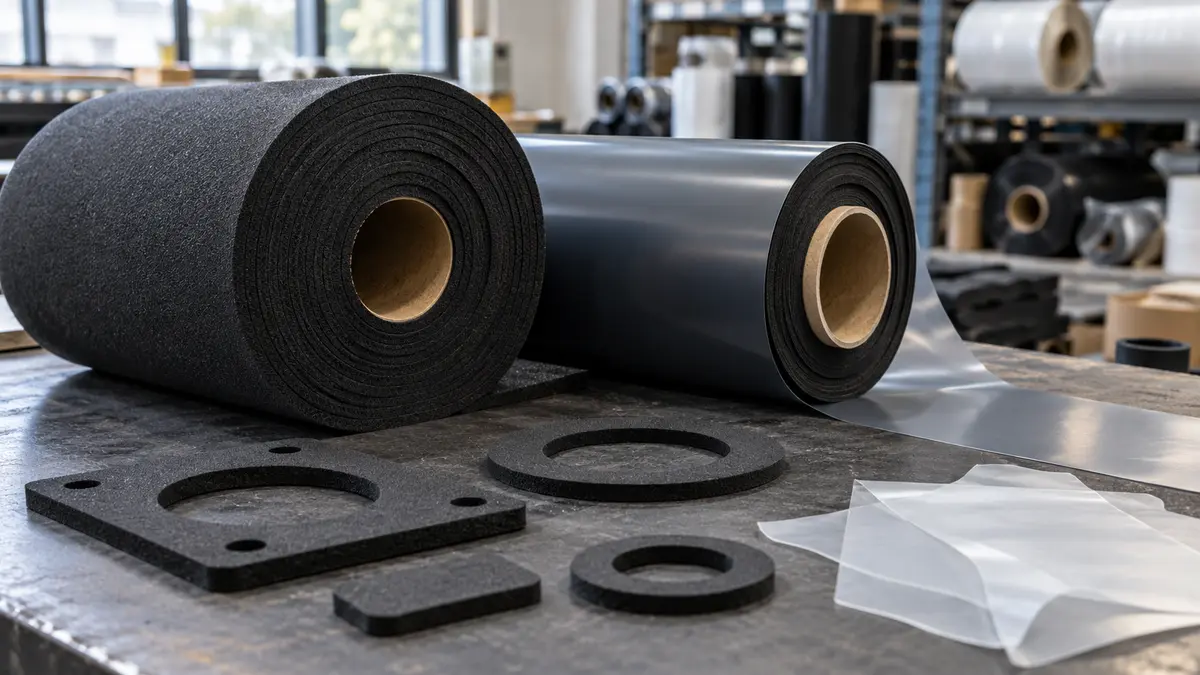
EE-1000L is a black, expanded EPDM synthetic-rubber mixture with a semi-closed-cell structure. Its intended uses include gasketing and insulation. The product is supplied in rolls or sheets, with two pressure-sensitive-adhesive backing options for attaching parts. Nitto lists low density and softness among its features. The density range is 70–150 kilograms per cubic metre under ASTM D1056. Under that same named standard, the table specifies a maximum compression deflection of 7.8 kilopascals at 25% compression and a maximum compression set of 25%.
The material’s listed tensile strength is at least 49 kilopascals and its elongation at least 250%, both under ASTM D412. The service-temperature range is −55°C to 121°C under JIS K 6767. Its flammability entry specifies a rate below 100 millimetres per minute under FMVSS 302. Nitto also lists resistance to ultraviolet light among the product’s features. These are the manufacturer’s product specifications, including their test references; the catalogue does not establish the material’s performance in every finished assembly.
Thin clearances and electronics housings
SCF gasket foam
SCF is Nitto’s thin, flexible gasket-sealing foam for small clearances. The company describes uses in gaps as small as 100 micrometres, with fine-width processing and conformity to uneven or curved surfaces. Applications include dustproofing and cushioning around speakers, microphones and LCDs, and soundproofing clearances around motors. The range contains several thickness bands: SCF100 is listed at 0.5–1.0 millimetres, SCF200 at 0.5–1.5, and SCF400 at 0.3 or 0.4 millimetres.
Thinner versions include 0.23-millimetre SCF406T, 0.2-millimetre SCF400T and SCF400TT at 0.10 or 0.15 millimetres. The P1500 version spans 0.3–1.5 millimetres and succeeds the P100UL and P200UL products. Nitto also offers a double-coated adhesive-tape option. The property table gives model-specific density and compression figures, with a note that they are observed sample values, not guarantees. For example, SCF406T and SCF400T each have a listed density of 0.06 grams per cubic centimetre and a 50% compression value of 0.9 newtons per square centimetre.
EH-2200 sulfur-free foam
EH-2200 is a semi-closed-cell EPDM sealing foam made without sulfur. Nitto associates that formulation with resistance to metal corrosion. Its listed applications include electronic circuit boards, connectors, LED lighting housings, speakers, lithium-ion batteries and automotive electronic-control units. Standard sheets are 900 millimetres wide and two metres long, in thicknesses from three to twenty millimetres. The company describes the foam as readily compressible and able to follow uneven surfaces.
The EH-2200 table lists apparent density of 0.11 grams per cubic centimetre, tensile strength of 6.0 newtons per square centimetre and elongation of 270%. Compressive hardness is listed separately at 25% and 50% compression. Those figures are sample observations. Nitto’s UL94 HBF flame-retardancy statement applies specifically to EH-2200 foam and has a thickness limitation. The qualification remains product-specific; it does not establish the classification of every foam variant or a complete lighting, battery or vehicle assembly.
Bonding and removable surface protection
No.512(M) double-coated tape
No.512(M) is a low-VOC double-coated adhesive tape with a nonwoven-fabric base. Nitto lists bonding and fixing foam materials, attaching plastic display plates, and bonding film or paper among its applications. The nonwoven base follows substrate contours, while the product is intended to adhere to foam, metal and plastic. Its specified thickness is 0.150 millimetres. The listed adhesive strength is 15.05 newtons per twenty millimetres in a 180-degree peel measurement. Nitto describes reduced volatile-organic-compound emissions as a product feature; that description is not a claim of zero emissions.
SPV films for processing metal
SPV-224R and SPV-214R use PVC-film carriers for protecting metal surfaces during processing, including deep drawing. Nitto lists stainless-steel plates, aluminium plates and nameplates among the substrates, alongside storage applications involving glass and aluminium sashes. The nominal thickness is 0.080 millimetres for SPV-224R and 0.120 millimetres for SPV-214R. Their respective adhesive-strength figures are 1.00 and 1.20 newtons per twenty millimetres, measured at a 180-degree peeling angle and a speed of 300 millimetres per minute.
Nitto qualifies these values as sample observations under particular test conditions. Its precautions identify substrate condition and surface treatment as variables affecting removal and residue. Painted boards can behave differently according to their paint-baking conditions, while treated aluminium can also show different peeling properties. The manufacturer calls for evaluation in the actual intended conditions before use. The materials are removable processing films; their purpose differs from the permanently bonded attachments elsewhere in the company’s automotive range.
Venting lamps and electrical enclosures
TEMISH automotive vent-filter parts combine a microporous membrane with a moulded component, including plastic or thermoplastic elastomer. The range includes CAPSEAL and VPF products for lamps, Z-series parts for electrical enclosures and E3-NTF products for small motors. CAPSEAL options vary by water resistance, air permeability and oil repellency. A cap protects the membrane. VPF products include single-layer PTFE and three-layer high-ventilation constructions, with different variants listed for LED headlamps, rear lamps and fog lamps.
The Z-series table lists Z3-NTF210SE and Z-PLUG-S at an air permeability of 130 cubic centimetres per minute, measured at a differential pressure of one kilopascal. Their listed water-entry pressure is 210 kilopascals under the JIS L1092 B method. Nitto presents these as representative values, not guaranteed performance. E3-NTF variants are listed for wiper and power-window motors. The product family’s lamp, electrical and small-motor specifications retain those different applications and testing bases.
Financial scale and business segments
Nitto’s revenue for the six months from April through September 2024 was ¥521,723 million, up 16.1% from ¥449,344 million a year earlier. Operating profit rose 69.5% to ¥109,267 million. Net profit was ¥80,009 million, an increase of 80.8%; profit attributable to owners of the parent was ¥79,975 million, up 80.9%. These are six-month group results under IFRS, published on 28 October 2024, rather than the revenue of the proposed Kentucky factory. The Industrial Tape segment generated revenue of ¥178,745 million and operating profit of ¥25,375 million. Nitto attributed sluggish automotive-material demand during the period to lower vehicle production.
Optronics revenue reached ¥286,755 million, while the Human Life segment recorded ¥65,184 million of revenue and an operating loss of ¥4,560 million. The financial document notes transfers of certain businesses from Industrial Tape to Optronics following management changes; its prior-year segment comparisons reflect those changes. The October 2024 financial filing supplies the reporting period, units and segment definitions for those figures.
Material functions in the portfolio
- Sealing joints: closed-cell EPTSEALER No.6800 foam.
- Cushioning small clearances: thin SCF gasket foam.
- Bonding foam and display plates: No.512(M) tape.
- Temporary metal-surface protection: SPV-224R and SPV-214R films.
- Venting selected lamps and enclosures: TEMISH filter parts.






Leave a comment