
Perspectives
Unspun: 3D weaving and the route to local production
A 2024 funding round supported Unspun’s weaving technology, while partner pilots, product development and later hub plans show the work of industrial deployment.
Published

Financing a manufacturing platform
Unspun’s July 2024 funding announcement centred on scaling machinery. The company raised $32 million in a Series B led by DCVC, with participation from Lowercarbon Capital, E12, Decathlon and SOSV. Its platform, then called Vega, weaves shaped textile products directly from yarn. The funding was intended to support expansion across North America and Europe, bringing the technology into manufacturing networks serving apparel brands.
Fashion Dive reported that DCVC general partner Milo Werner would join Unspun’s board. At the time, co-founder Walden Lam was chief executive. The investment connected a machine-development business with a proposed production model: manufacturers would use the equipment to make smaller quantities closer to their customers. Following that model requires work across textile development, factory operations and commercial partnerships.

From experiments to a microfactory
Unspun’s current company history describes an early period in which custom-fit clothing and experimental weaving developed alongside each other. In 2018, the team prototyped jeans using body-scanning technology and opened an office and retail location on San Francisco’s de Haro Street. The clothing business provided a way to investigate production against individual orders. Meanwhile, separate machine prototypes explored how fabric could be formed into shapes during weaving.
A 2020 milestone in the company’s account was a woven tube whose diameter could change as it was made. In 2023, a second machine generation added automated jacquard functionality, and the company opened a California microfactory. Its current history uses the name OneWeave for the system formerly known as Vega. These milestones describe several layers of development: controlling shape, introducing patterned textiles and creating a place where production could be demonstrated through actual products.

Co-founder Beth Esponnette’s background helps explain the combination of material experimentation and product design. In a June 2026 Stanford d.school feature, she described studying fibre science and apparel design before pursuing graduate design work. Her account of excess material at an outdoor-clothing business prompted a broader question about how products could be manufactured in response to demand. The problem concerned both physical materials and the decisions that determine how many goods are made.
The university’s profile describes a design practice built around questioning assumptions and working across disciplines. Esponnette experimented with layers of material and considered how production itself might change. After Stanford, she went to the University of Oregon, where she sought collaborators for the business. That trajectory places Unspun’s machinery within a longer effort to connect garment design, physical prototyping and manufacturing methods. The profile presents her experience as a designer and founder, rather than a technical specification for every product the company now makes.

The role of the Oakland facility
An earlier funding round established the immediate setting for that work. In June 2023, Fashion Dive reported a $14 million Series A led by Lowercarbon Capital. Unspun planned an Oakland microfactory that would serve as a demonstration site and headquarters. Initial brand partnerships were to be produced there, with woven pants as the first product focus. The company then envisaged bringing equipment into partners’ existing facilities as production expanded.
The 2023 report also identified work surrounding the weaving machine. Potential factory roles included operations, product finishing, quality control, fulfilment and management. A company spokesperson estimated one to two weeks of training for employees to begin using the technology. That estimate was a statement about the proposed operating model. The list of roles is equally instructive: making shaped fabric still leaves a set of responsibilities for preparing, checking and delivering a saleable product. The microfactory was intended to give partners a setting in which to explore those responsibilities together.

Custom-fit denim was a separate workflow
Unspun’s own explanation distinguishes its historical custom-fit jeans business from its 3D weaving platform. Jeans customers selected a cut, colour, rise, hem length and thread colour, then supplied an iPhone body scan and fit survey. Software combined those choices and measurements into individual patterns. The company checked the fit digitally before sending the patterns to a partner factory for cutting, sewing and direct shipment to the customer.
That workflow used digital patternmaking to organise production after an order. The physical jeans were assembled through cutting and sewing. In its current FAQ, Unspun says it has wound down new custom-fit denim orders to concentrate its team on the weaving platform and partnerships with brands and manufacturers. It continues to offer support for previous orders. Bringing personalised fit into the weaving system remains part of the company’s longer-term vision. The distinction matters when interpreting its history: a body-scanned pair of jeans and a pair made with shaped weaving represent different production routes, even when both are discussed under the same corporate name.

- Body scan and fit preferences.
- Individual patterns and digital checks.
- Partner cutting, sewing and delivery.
What the machine changes
In Unspun’s technical explainer, thousands of yarns are interlaced to form a seamless tube that becomes a trouser leg. The machine produces a second tube, and the legs are joined at the crotch seam. Software can adjust the tube’s diameter during weaving, incorporating part of the garment’s shape into the textile. This places shape-making within fabric production, while retaining assembly work where the garment requires it.
The process also has a different textile construction from circular knitting. Knitting creates fabric through linked loops; weaving interlaces yarns. Both can produce tubular forms, but the yarn structure differs. Likewise, Unspun’s process works with yarn rather than the deposited material used in common additive-manufacturing methods. These distinctions clarify the term “3D weaving”: it describes how the textile is constructed and shaped. A machine creates a woven component that contributes directly to the garment’s form, with joining and finishing considered as part of the wider production workflow.

A design case: Teget’s Static Noise collection
The collaboration with Ana Kraš’s lifestyle brand Teget provides a concrete example of product development. For the Static Noise collection, the teams developed a baggy trouser in three colourways. Kraš wanted patterns that suggested static snow and digital glitches. Unspun’s weavers translated sketches into swatches, then revised the yarn palette through successive reviews. Three jacquard patterns were saved in the machine’s operating system, turning the agreed designs into production instructions.
Two of the patterns also became pillowcases in Teget’s homeware range. The company’s case study says the trouser legs taper by approximately 35%, demonstrating variable-diameter shaping within that collection. The example combines a specific silhouette with controlled surface patterning. Its development sequence runs from an artist’s visual idea through textile samples to repeatable machine settings. The homeware extension also shows how the same pattern-development work can feed a different product format. Unspun describes the collection as limited-quantity production in California, giving the collaboration a defined manufacturing setting.

Materials and finishing remain product choices
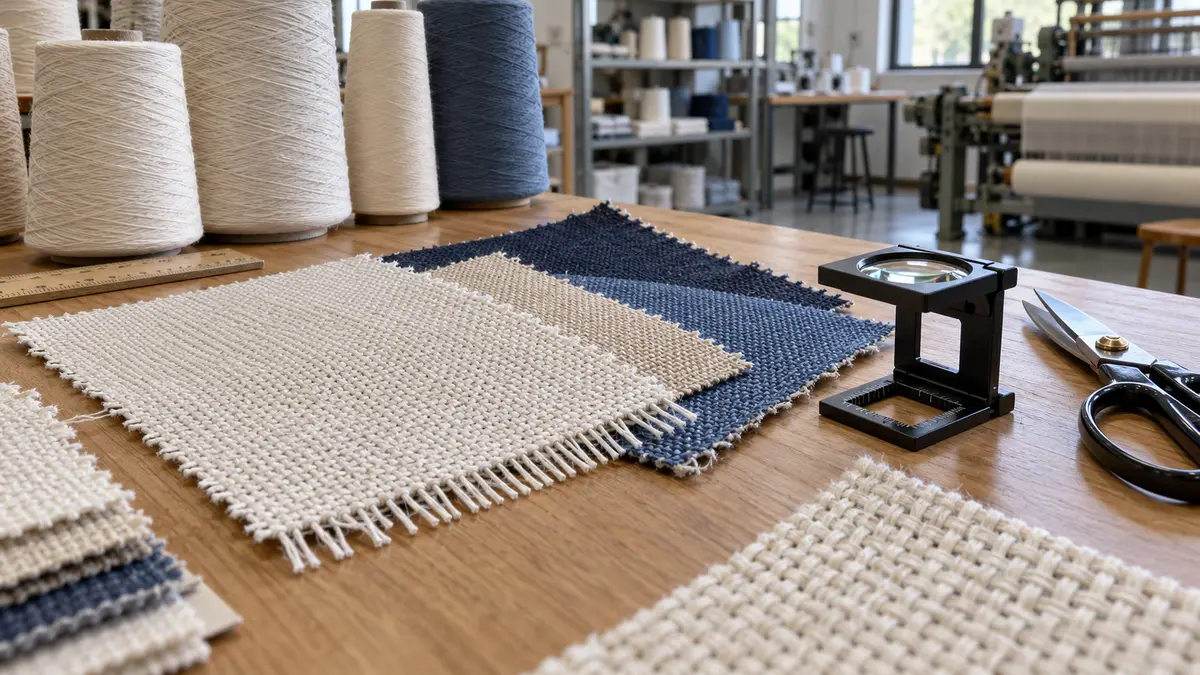
The company’s current product showcase lists examples built around 2x1 basket weaves for trousers and accessories. Several entries specify organic cotton for both warp and weft. A comfort-stretch example instead lists a cotton warp and a weft containing 98% cotton and 2% spandex. These are specifications for particular showcased constructions. They demonstrate that the product menu includes decisions about yarn composition as well as garment shape and appearance.
The same showcase records finishing operations. Some examples are piece-dyed and washed; others list garment washing, dyeing and laser finishing by Officina. A collaboration with designer Celine Kwan includes washed and screen-printed cotton. Those details give substance to the stages surrounding weaving. The shaped textile receives its final look through a product-specific combination of yarn selection, colouring and surface treatment. For a brand evaluating the platform, the relevant object is therefore a complete material-and-finish specification, alongside the silhouette produced on the machine. Current samples illustrate that development work without establishing the specifications of every earlier collection.

Walmart’s pilot and a longer-term ambition
Walmart’s March 2024 announcement described a pilot exploring how Vega could fit into its supply chain. The first application was men’s chinos. Walmart highlighted seamless legs and labels woven into the garment as product features to investigate. The retailer connected those features with a proposed model of production closer to demand and the point of sale.
The announcement also reported Unspun’s ambition to have 350 weaving machines operating by 2030. That number belonged to a future deployment goal. The pilot’s practical purpose was to explore an application within a large retailer’s sourcing system. A specific product category gave the work a starting point, while the proposed machine network described its possible scale. Keeping those two levels visible allows the reader to follow the commercial relationship without interpreting an early test as evidence that the full network had already been installed.
A European partnership with Decathlon Pulse
In October 2024, Decathlon Pulse and Unspun announced a partnership involving investment and a multi-year offtake agreement running through 2030. The exact terms were undisclosed. Decathlon Pulse, the sports group’s investment arm and start-up studio, intended to act as an industrial partner in bringing the weaving technology to Europe. The announcement envisaged production serving multiple European brands, extending the relationship beyond a single named clothing line.
The partners described the machine’s output as semi-finished products made directly from yarn. That formulation fits a manufacturing system in which weaving contributes garment shape and subsequent operations complete the product. Their stated aim was local, low-inventory production using microfactories. An offtake agreement supplies a commercial framework for that development, while investment supports the platform behind it. The announcement establishes the relationship and its intended direction; it does not provide a completed European factory count or disclose the quantities covered by the agreement. Its horizon through 2030 is a contractual timeframe, distinct from a report of current installed capacity.
Reading the environmental comparison
Unspun commissioned Green Story to assess the environmental implications of its manufacturing model. In the company’s explanation, a cotton-trouser production comparison found 24% lower greenhouse-gas emissions and 25% lower energy use against a conventional route using air-jet-woven fabric. A second scenario added different sales assumptions: 70% sell-through for conventional production and 100% for on-demand production. Under that model, the reported reductions became 53% for emissions, 49% for energy and 39% for fresh water.
The two comparisons answer different questions. One examines the production route; the other also assigns resources to garments made but left unsold. The sell-through assumptions are inputs to the company’s comparison, rather than measured performance for every retailer. Its stated scope runs through production and the point of sale. These figures therefore describe modelled results under specified conditions. They should be interpreted with the manufacturing boundary and inventory assumptions attached.
Moving from samples to an operating relationship
Unspun’s current commercial pages address manufacturers and brands separately. Manufacturers are offered a system intended to simplify production from yarn to shaped garments. For brands, the company proposes starting with a pilot and then deciding whether to expand. It identifies trousers and accessories using 2x1 basket weaves as the current product focus. This gives a prospective partner a defined entry point: select a suitable product, explore the manufacturing route and assess the result before committing to wider use. The published offer describes how Unspun wants partners to engage with the platform, while individual implementations depend on the product and production relationship being developed.
An account of an Unspun microfactory summit adds an implementation perspective. Enrique Silla, founder of denim-technology company Jeanologia, discussed the challenge of introducing unfamiliar technology and the skills needed to use it. In Unspun’s summary, hands-on training and responsive troubleshooting were central to Jeanologia’s relationships with manufacturers. The lesson concerned the support required to turn a machine into a useful part of a customer’s operation.
For a manufacturing platform, that support sits alongside invention. Operators need to learn the workflow, partners need help with questions that arise in use, and commercial relationships continue after equipment is introduced. The summit account presents this as an example for the company to learn from. It does not establish that the two businesses signed a manufacturing contract. Its value in the development story is more specific: it records Unspun considering how another machinery business approaches adoption and service.
Leadership and the next proposed hubs
A later leadership change accompanied the deployment effort. On 3 March 2026, Unspun announced Arne Arens as chief executive. He had previously led The North Face globally and served as chief executive of Boardriders. Co-founder and chief technology officer Kevin Martin linked the appointment to work with more brands and manufacturers. The company presented Arens’s experience in consumer brands and apparel supply chains as relevant to that stage of development. The dated appointment also marks a change from the leadership described in the July 2024 funding report, when Walden Lam was chief executive.
In a company update displayed in July 2026, Unspun described plans for domestic manufacturing hubs in the United States. Walmart and REI had signed letters of support, and the named supply-chain participants included Bethel Industries, Peckham and PDS/GSC Link. Unspun said equipment was ready for deployment while it evaluated locations, infrastructure requirements and workforce-training programmes. The update describes preparation for a network whose operating locations were still being assessed.
Letters of support indicate interest in the proposed direction; they leave the details of a production relationship to subsequent work. The site and training assessments identify practical requirements for establishing hubs. Together with the earlier retailer pilot, European offtake agreement and product collaborations, the update shows several routes toward deployment. Each relationship has its own form and stage. Following those distinctions gives a clearer view of how Unspun is attempting to connect shaped weaving with apparel production at a larger scale.





Leave a comment