
Perspectives
Formlabs: Micronics joins a wider SLS manufacturing workflow
Formlabs added Micronics to its SLS team in 2024, alongside a growing workflow of software, powders and post-processing tools for manufacturers.
Published

Formlabs acquired Micronics in July 2024.
The acquisition brought a Wisconsin printing startup into the selective laser sintering team at Formlabs, headquartered in Somerville, Massachusetts. Micronics had announced its Micron printer through Kickstarter the previous month. Formlabs presented the agreement as a way to combine expertise in accessible powder printing, with the incoming team working on its SLS development. The announcement placed people and engineering capability at the center of the transaction. Formlabs already supplied printers, materials, software and post-processing equipment across its business.
For Kickstarter backers, the change also concerned an existing product campaign. In its July announcement, Formlabs said backers would receive refunds after the acquisition closed and a credit toward a Formlabs printer. That was a stated arrangement for the campaign, rather than a report documenting individual payments. The public announcement did not set out a purchase price.
From a digital model to a powder bed
SLS builds a part by selectively joining polymer powder. A laser follows successive cross-sections of a digital model, while the surrounding unfused powder holds the emerging object in place. This permits overhanging features and interlocking geometries without separate support structures. Preparation software arranges the parts within a three-dimensional build space and divides the models into layers. Several components can therefore share a chamber, including components with different shapes, provided their arrangement respects the process requirements.

The machine finishing its scan is only one stage in getting usable components. Cooling helps control distortion and preserve the intended mechanical properties. Parts are then extracted and excess powder removed. Recovered material can return to later builds with fresh powder added, because exposure to heat changes the unused material. A removable chamber allows another build while the earlier batch continues cooling. Formlabs’ current technical guide separates the workflow into these stages:
- Prepare and arrange the digital models, then print the layers.
- Allow the build to cool before extracting its contents.
- Recover suitable loose powder and clean the finished parts.
Software changes the laser’s journey
Before the acquisition, Formlabs had already changed how its Fuse printers handled a build. Its February 2024 PreForm 3.34.0 announcement described a revised laser path for the Fuse 1+ 30W. Earlier paths moved across the layer in a comparatively linear pattern, with pauses between separated regions. The revision aimed to keep the laser working more continuously rather than repeatedly stopping and restarting. This was a software change to an existing printing process, with the powder and physical machine still part of the same production system.

Formlabs reported faster printing and smaller files from that revision. Those results belonged to the specified software and Nylon 12 workflow; they were not a promise for every material and geometry. The release also added ways to obtain Fuse Blast logs and update its firmware through PreForm. For Windows installations, automatic updating could be switched off. That option mattered for customers maintaining a validated process, where changing a software version may require deliberate review before the next production run.
Polypropylene expands the material choices
Another development preceded Micronics: Formlabs introduced Polypropylene Powder in January 2024. It gave Fuse users a route to parts made from the thermoplastic itself, alongside other printing approaches that simulate polypropylene’s characteristics with resin. The company positioned the material for ductile, lightweight components and small production runs. Its examples included packaging-related prototypes, fluid-handling components and manufacturing aids. The attraction was the ability to work on a familiar industrial polymer while changing a design without first commissioning a new mold.

Powder consumption still depended on the build. The announcement specified a 50% refresh rate for polypropylene, meaning a new mixture contained equal shares of fresh and recovered powder. That differs from assuming every kilogram left in the chamber can circulate indefinitely without additions. Formlabs also described polypropylene’s lower sintered density, which changes the material needed for a given part volume. Its published comparison put that density at 0.89 grams per cubic centimeter. These are separate inputs to cost: powder price, part volume, packing and refresh requirements all affect the result. A cheaper kilogram alone does not establish a cheaper finished component.
White parts and tougher nylon
In October 2024, after the acquisition announcement, the Fuse material range expanded again with Nylon 12 White Powder and Nylon 12 Tough Powder. White nylon addressed a practical issue for product development: a dark prototype can be harder to color to match a brand or final design. A white starting material supports painting, dyeing and coating for customer-facing samples. This gives designers another way to carry a powder-printing workflow into appearance reviews, where the shape and the surface treatment both influence a product decision.

The Tough formulation targeted ductility and dimensional accuracy, including the difficulties presented by long, thin geometries. Formlabs also emphasized its lower fresh-powder requirement. Those characteristics concern different aspects of production: whether a feature survives flexing, whether dimensions remain suitable, and how much material enters another build. They should be evaluated together for the intended component. The launch text discussed possible medical applications for white nylon but also said certification was ongoing. A material announcement therefore cannot substitute for checking the applicable certification and manufacturing process for a particular device.
More control over materials and settings
The October 2024 open-platform announcement separated several kinds of access. Open Material Mode was offered for a one-time licence fee per printer, allowing expert users to work beyond the company’s own material selection. Print Settings Editor offered a different form of control: adjustment of parameters within PreForm. Certified Materials formed another route, pairing selected third-party materials with prepared settings. A laboratory developing a new powder and a manufacturer choosing an established material could consequently need quite different combinations of these tools.

The platform also included an API and developer resources for integrating software workflows. A software development kit gave partners a starting point for building those connections. That placed preparation and coordination alongside the physical act of printing. A business could explore connections between its existing applications and the printer software, rather than requiring every step to start in the same interface. Customization carries its own work, however. Access to settings gives an experienced team the means to establish a process; it does not establish that every experimental material already has a dependable, qualified production recipe.
Cleaning becomes a production step
Formlabs had introduced Fuse Blast in November 2023, well before the Micronics agreement. Its job was to automate media blasting after parts had been extracted, using a rotating basket and abrasive media to remove remaining powder. This complemented Fuse Sift’s powder-handling role. An optional polishing system addressed surface finish as an additional capability. The distinction matters when planning equipment: recovering reusable material and preparing a clean component for use are connected operations, but they are not interchangeable tasks performed by a single generic powder station.

The launch included accounts from Labconco and contract manufacturer Autotiv. Their problem was the labor spent manually cleaning batches, including many small components. Formlabs presented automation as a way to shift that effort toward design and other production work. It advertised substantial reductions in hands-on time, with results dependent on the stated workflow. Autotiv also used a printer from another manufacturer, illustrating that a finishing machine could fit into an existing production arrangement rather than requiring replacement of every earlier piece of equipment.
A clean part can receive another finish
Formlabs’ current finishing guide describes choices beyond removing powder. Media polishing, vibratory tumbling and vapor smoothing change surfaces through different mechanisms. Coatings can add another material to the exterior, while coloring changes appearance. These operations bring equipment, skills and process choices of their own. A part intended for an internal fixture may need a different treatment from a visible product enclosure. The desired result determines whether a business can finish parts within its existing workshop or needs a specialist service provider.
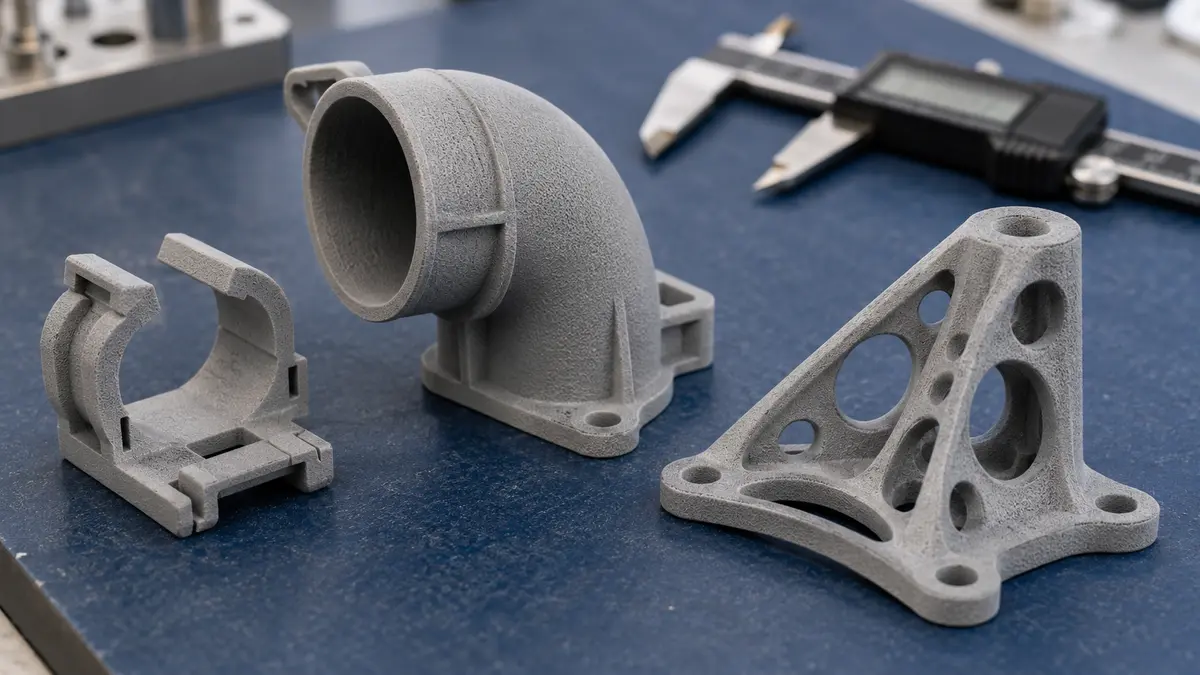
Color also involves a choice between methods. Dye can reach recessed features, but it cannot make an already dark part lighter. Painting provides more control over a reference color or localized detail, while a painted surface may suffer abrasion in use. The guide also distinguishes ordinary powder coating from formulations suitable for heat-sensitive substrates. It describes metal plating as another specialist option for changing surface properties. A finish therefore belongs in the component specification early enough to assess its effects. Choosing it only after the shape is approved can leave additional processing, dimensional or appearance questions unresolved.
AMETEK Brookfield connects printing to validation
A November 2024 Formlabs case study at AMETEK Brookfield described SLS working alongside other equipment at its Middleboro, Massachusetts, operation. The company makes instruments for characterizing materials, and its manufacturing engineering work includes fixtures, tooling and production components. For a small electronics clip, the issue with milling was repeated hand-loading rather than an expensive raw material. Brookfield reported moving that component from a $25 cost to $3 through SLS. The comparison concerned that particular clip and workflow, rather than a general discount on machining.
The same account described a supplier delay affecting 30 spring retainers. Brookfield reverse engineered the component, tested its function and durability, and produced a replacement batch in under two weeks. Testing included heat, life-cycle demands and shipping between facilities. The value was continuity while a supplier could not deliver. Brookfield retained FDM machines for other tasks, including quick items needed on the assembly floor. Its adoption of SLS added another production option, with the choice depending on the component and its required use.
Brose uses powder printing for production gaps
The November 2024 Brose case showed how prototype volumes can themselves become substantial. For a seat suspension mat, the automotive supplier combined resin-printed elements with glass-filled nylon components made by SLS. It assembled 150 mats for testing, with six SLS pieces in each. Those assemblies also contained three resin-printed elements apiece, bringing two material workflows together. The project brought different printing processes into one assembly, rather than treating them as competing answers to every part. Testing a complete seat required enough representative components to move beyond a single visual model on an engineer’s desk.
Brose also described gap production for components needed before conventional tooling became available. The case listed a BMW X7 seat-component project with a planned volume of 250,000 pieces and a separate Bowden release project of 20,000. Those figures were project volumes, not confirmation that all parts had shipped. The listed build quantities and monthly output were separate measures. Brose used its Fuse machines for prototypes, manufacturing aids and end-use work, with the decision to produce final components tied to qualification and confidence in repeatable results.
Prime Inspections adapts a field tool
Prime Inspections offered another example in a November 2024 customer account. It needed a modular holder for digital inspection panels used around large pipelines. The design resembled a band made from interlocking links, allowing operators to attach and remove equipment and alter the assembly for the pipe. Early development considered several fabrication routes. After using carbon-filled nylon, the company moved toward polypropylene when field conditions revealed a need for impact resistance in colder weather. Material choice followed the demands of the actual equipment and environment.
Prime described printing links in batches, adding a second Fuse printer and developing other holders for inspection work on storage tanks. For tanks, the team developed a magnetic holder instead of an encircling band. Its account also identified orders through an inspection-equipment supplier, giving the printed assembly a route beyond the company’s own crews. This was a customer’s experience of developing a particular tool. The printer’s contribution was the ability to revise geometry and make components in-house; the account did not establish a general safety certification for inspection equipment or remove the need to validate it for field use.
A later move into larger builds
A separate development arrived in June 2026, when Formlabs announced the Fuse X1. The dated release specified a 330 × 330 × 565 millimeter build volume and a wider system of powder handling, including a modular build unit, recovery station and vacuum conveyor. Formlabs described thermal control across multiple zones and layer monitoring designed to detect problems during a build. It was a larger-format extension of the powder-printing workflow, announced nearly two years after Micronics joined the company.
The June announcement opened orders and scheduled deliveries for the fourth quarter of 2026. It also reported early customer use, which is different from establishing general delivery to everyone ordering the machine. The announced hardware starting price was $84,999, excluding assumptions about a complete installation. The release did not attribute this printer directly to the acquisition. Together, the dated developments show Formlabs extending several connected parts of its SLS offering: people, software, materials, cleaning and larger equipment. For manufacturers, the useful comparison is the resulting production process and its fit with a particular workload, rather than the acquisition announcement considered alone.





Leave a comment