
Perspectives
Highview’s Carrington project: liquid-air storage, finance and grid stability
Carrington’s £300 million financing provides the starting point for Highview’s liquid-air storage programme and later, separately funded grid-stability projects.
Published
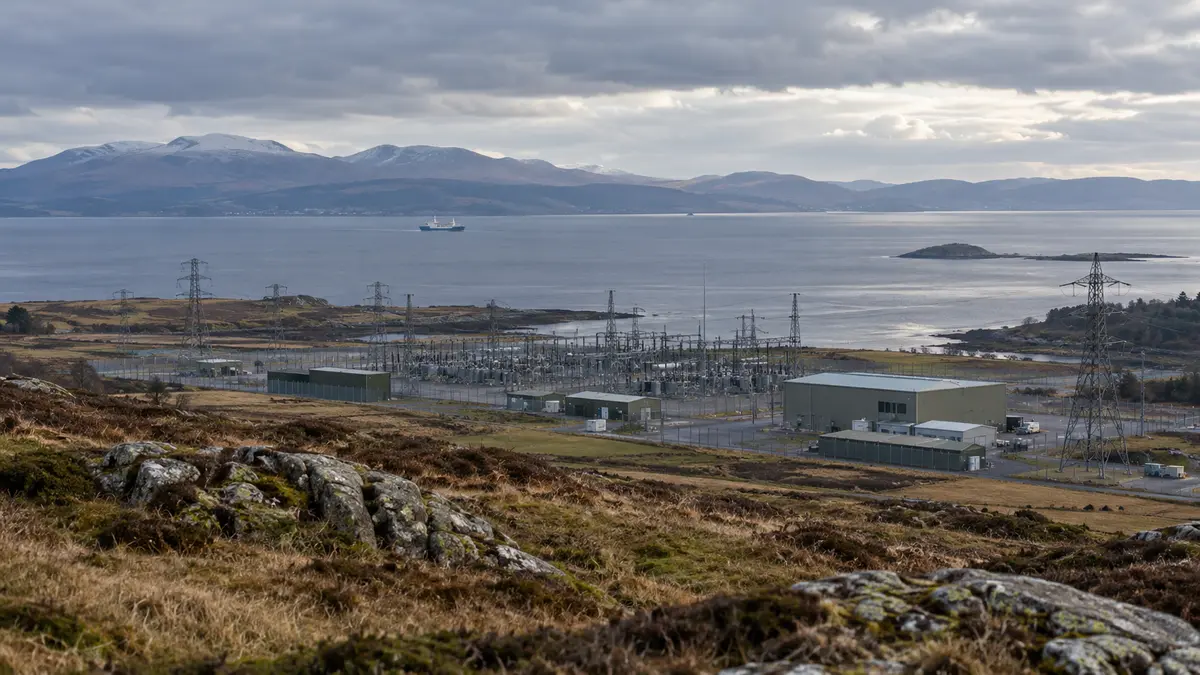
Highview Power’s £300 million liquid-air storage project at Carrington near Manchester secured backing from a group including Centrica and the UK Infrastructure Bank in June 2024. The planned facility would hold energy from surplus electricity and return it to the grid when demand increased. Work had begun at Trafford Energy Park when the financing was announced. The design was intended to retain energy for several weeks. Highview expected more than 700 jobs across construction, supply-chain activity and staffing. It estimated that the facility could supply approximately 480,000 homes. The original timetable envisaged operation in 2026; later company announcements set separate dates for grid-stability services and liquid-air storage operation.
Carrington was close to wind generation in the Irish Sea and Scotland, Highview co-founder and chief executive Richard Butland told BBC News. Butland said large-scale deployment would be cost-effective. The company proposed a delivery hub in Manchester to support a wider rollout. Greater Manchester mayor Andy Burnham welcomed the employment, investment and renewable-energy plans.

Hunterston attracts a separate funding round
In November 2025, Highview announced a separate £130 million round for the first stage of its Hunterston development in Scotland. The Scottish National Investment Bank committed £45 million, approximately 34.6% of the round by arithmetic. The project occupies Peel Ports land in North Ayrshire. It is intended to improve transmission of Scottish generation towards areas with high electricity demand. Its first phase is a stability island providing inertia, short-circuit and voltage support independently of the energy-storage installation. A second phase combines liquid-air storage and lithium-ion batteries in a planned 3.2 GWh hybrid facility. Highview also plans grid analytics for monitoring energy use and network activity. The Bank associates its investment with its net-zero and regional-development missions. Across construction of all phases, the project was expected to support approximately 1,000 onsite jobs and 650 supply-chain jobs.
Rotating machines and grid-forming controls
Synchronous condensers are alternating-current motors that rotate without a mechanical load. They can provide inertia, short-circuit support and dynamic voltage control. An additional flywheel increases the rotating mass and its inertia contribution. A flywheel energy-storage system instead converts electricity into kinetic energy through a motor, then returns energy through generator operation. Voltage-source converters equipped with grid-forming controls provide another means of delivering stability services. Rotating machinery and controlled power electronics supply network functions through different physical arrangements.

Voltage support is a local service
Voltage drives electrical charge through a conductor. Britain’s transmission system moves power at up to 400,000 volts, compared with a typical household supply of 230 volts. National Grid Electricity Transmission maintains the transmission infrastructure; local distribution operators use step-down transformers and deliver lower-voltage power to homes and businesses. The transmission network uses high voltage to move large amounts of electricity efficiently, and transformers reduce it before power reaches local customers. Voltage varies across the network as demand and generation change, so operators manage conditions at different locations. Injecting reactive power can raise voltage, while absorbing reactive power can lower it. Generating stations, dedicated support equipment and network infrastructure can all affect these conditions. NESO manages the voltage profile alongside the balance between electricity production and consumption. Its support arrangements include equipment that supplies or absorbs reactive power where the network requires it.
Reactive power arises from the electric and magnetic fields associated with alternating-current equipment. Its effect on voltage is local, whereas frequency is shared across the interconnected electricity system. NESO instructs generators and other asset owners to produce or absorb reactive power to maintain the required voltage profile. Obligatory reactive-power services cover the baseline provision required from relevant generators; enhanced reactive-power services go beyond those requirements. Through its reactive-power arrangements, the operator procures network support while seeking the lowest cost to consumers. Asset owners participate according to the applicable technical and commercial requirements. These services operate alongside the supply of active power used by customers.
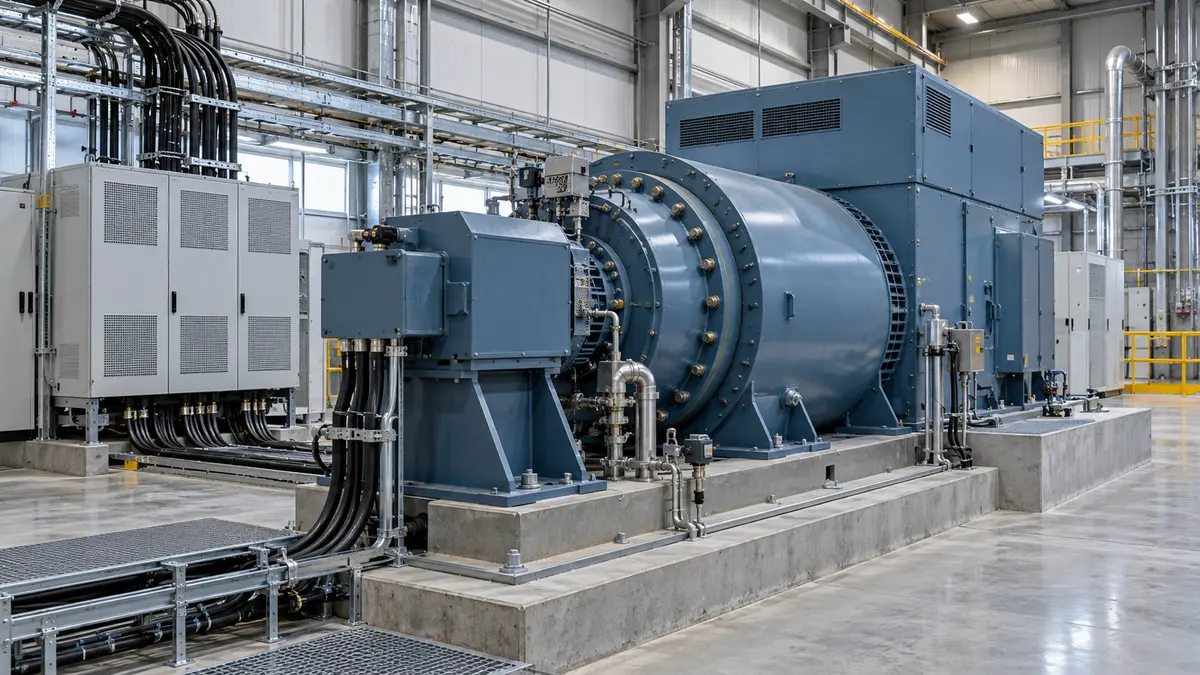
Equipment inside a synchronous condenser installation
A synchronous condenser uses field excitation to adjust its reactive-power output. Increasing or reducing field current allows the machine to generate or absorb reactive power as network conditions change. Static or brushless excitation systems can be used. The rotating machine also contributes short-circuit current and synchronous inertia. Typical installation components include the stator and rotor, cooling equipment, excitation equipment, lubrication-oil supply, a step-up transformer and an auxiliary transformer. Cooling can use hydrogen, air or water. Electrical losses consume active power and contribute to operating costs. ENTSO-E identifies applications on long transmission lines, weak alternating-current networks and systems with substantial power-electronics penetration. Condensers also support connections involving wind, solar and high-voltage direct-current infrastructure. Depending on their design, they can remain connected during low-voltage disturbances and provide short-term overload support. With suitable equipment, field forcing can deliver two to two-and-a-half times rated field current and voltage for up to ten seconds. Additional flywheels can increase inertia. Research and development includes larger flywheels, improved bearings, high-temperature superconducting machines and possible uses for thermal losses.
Scotland’s stability procurement
NESO awarded ten contracts under Stability Pathfinder Phase 2, with a combined value of £323 million. They covered five synchronous condensers and five grid-forming batteries. The procurement specified 11.55 GVA of short-circuit level in Scotland and 6.75 GVA seconds of inertia for Great Britain. The condensers provide generator-like stability without generating power for customers. Grid-forming batteries contribute short-circuit level and inertia through controls designed to reproduce relevant generator behaviour. By 11.03.2025, the first two projects had gone live, including Great Britain’s first grid-forming battery site. NESO estimated approximately £500 million of cost-saving benefits over the ten-year contracts. The assets were initially contracted for ten years and were expected to have opportunities to participate in dedicated stability-service markets from 2035.

Storing electricity as liquid air
Liquid Air Energy Storage, usually abbreviated to LAES, uses electricity to refrigerate air until it becomes a liquid. The liquid is retained in tanks, then expanded when electricity is needed. A generating system captures energy from the expanding gas and returns electrical power to the grid. Highview combines this storage process with infrastructure and system services. Its technology platform allows different charging and discharging configurations and is intended for extended energy-storage periods. In Hunterston’s planned hybrid design, liquid-air storage sits alongside lithium-ion batteries.
Highview received more than £2 million through successive Innovate UK and Industrial Strategy Challenge Fund investments, beginning with a proof-of-market study in 2012. Its development work included a patented system intended to provide rapid enhanced frequency response from future LAES plants. The project aimed to assess the commercial benefits of participating in future National Grid response tenders and demand for faster services internationally. Electrically driven compressor refrigeration condenses the air into a cryogenic fluid. As an industrial material, liquid air is pale blue and serves as a refrigerant and a source of oxygen, nitrogen and other gases. During discharge, ambient or waste heat is applied, and an expansion turbo-generator captures work from the gas. The generator is typically synchronous and supplies inertia. By February 2025, Highview had projects in Australia and Japan as well as its British programme. The company had secured £300 million in its June 2024 funding round; total investment stood at £377 million, including Centrica’s £70 million commitment, according to UK Research and Innovation’s dated account. Hunterston was the first of four proposed second-phase projects across Scotland and northern England.

Centrica’s investment structure
Centrica’s June 2024 commitment comprised £25 million of convertible debt in Highview Enterprises Limited, the holding company, and £45 million of project debt for Carrington, phased over construction. The agreement included rights to equity participation and energy optimisation in future Highview projects. Centrica valued the wider project pipeline at £9 billion. Its investment formed part of a company programme to deploy £600 million–£800 million annually until 2028. Chief executive Chris O’Shea linked the partnership to managing peaks in demand and maintaining supply when wind and solar generation were unavailable. Centrica planned to contribute energy-transition and power-storage expertise alongside its capital. The partnership belonged to its green investment programme, targeting assets that complemented existing capabilities and balanced the company’s portfolio. Highview had developed the technology over seventeen years with government support, according to Centrica’s June 2024 announcement. Carrington’s announced design specified 300 MWh of stored energy and 50 MW of output. Dividing those quantities gives six hours at the stated output rate. The company presented Carrington as the foundation for a larger British rollout and international partnerships. The June announcement initially expected operation in 2026, ahead of the revised phase-specific dates issued in November 2025.
The second-phase development programme
Highview announced its Hunterston proposal in October 2024 following a meeting with Scotland’s First Minister John Swinney in London. The company had secured development rights at the Peel Ports site and intended to build a 2.5 GWh LAES installation. Development was divided into grid connection and stability works, followed by the storage build-out, for which planning was to begin. Highview estimated that the proposed 2.5 GWh design could supply 650,000 homes for 12.5 hours. The four-project programme also included an Aberdeenshire proposal associated with North Sea renewable generation and local grid support. Butland described a programme intended to unlock 10 GWh of long-duration storage. Swinney associated the Ayrshire development with skilled employment and the renewable-energy supply chain. NESO strategic-planning director and chief engineer Julian Leslie welcomed the proposal, referring to an 81 GWh long-duration-storage requirement by 2030 in the operator’s Holistic Transition Pathway. The June financing syndicate included Sumitomo, Rio Tinto, Goldman Sachs, KIRKBI and Mosaic Capital alongside the UK Infrastructure Bank and Centrica. Highview’s November 2025 Hunterston plan subsequently specified a 3.2 GWh hybrid combining LAES and batteries.

The cap-and-floor framework
The Department for Energy Security and Net Zero opened its long-duration-storage investment consultation on 09.01.2024 and published its response on 10.10.2024. The government confirmed its intention to establish a cap-and-floor scheme, with Ofgem acting as regulator and investment-framework delivery body. The consultation covered eligibility criteria, scheme design and delivery arrangements. It attracted 113 responses from developers, trade associations, asset owners, academics, investors and technology participants. Most supported a cap-and-floor approach. The government associated the framework with overcoming investment barriers facing storage under existing energy-market arrangements and planned further work with Ofgem, NESO and industry. Under Ofgem’s mechanism, revenue below an approved floor can receive support through consumer charges. Revenue above the cap is returned to consumers through reduced network charges. The scheme therefore combines a minimum-revenue arrangement with the sharing of excess revenues. It applies to qualifying long-duration-storage projects through the regulator’s assessment process.
Ofgem’s first-window eligibility decision advanced qualifying proposals into a project-assessment stage beginning in September 2025. Highview identified Hunterston and Killingholme as eligible projects. The regulator’s March 2025 technical decision requires eligible installations to discharge continuously at full power for at least eight hours. It sets minimum power thresholds of 100 MW for stream 1 and 50 MW for stream 2. Project applications must also demonstrate sufficiently mature cost estimates, a submitted grid-connection application and the appropriate planning position. Proposals deliverable by 2030 receive flexibility to demonstrate that consent can be secured within their delivery timetable. Relevant environmental permits, generation licences where applicable, and evidence of landownership, leases or binding options form part of the requirements. Ofgem sought credible costs broadly equivalent to an Outline Business Case, using a common Level 0 cost breakdown. Front-end engineering studies appropriate to the development stage were to be supplied where available. Developers were not expected to complete every engineering study before applying. They had to answer requests for further information and report developments affecting delivery. Grid-connection reform could bring connection offers forward or delay them; applicants therefore needed evidence of a submitted connection application. Eligibility is followed by further project assessment within the support programme. In March 2025, Ofgem also expected to set developer progress milestones in the second quarter of 2026 to support timely delivery.

Phased delivery at two sites
In November 2025, Highview expected Hunterston’s stability island to operate by January 2028 and the full facility by 2030. Carrington’s revised timetable placed the first stability phase in August 2026 and liquid-air operation in 2027. More than £500 million had been raised to commercialise and deploy the company’s Millennium Series of planned 3.2 GWh hybrid facilities. The programme was to include additional British plants following Carrington. Butland linked the Hunterston first phase to reducing curtailment and strengthening the supply chain using experience gained in Manchester. Centrica continued as an investor and strategic partner. O’Shea associated Hunterston’s grid and analytics services with balancing supply and demand as renewable generation varied. The dates remained the company’s announced development timetable as of November 2025.
- Carrington: announced 300 MWh storage and 50 MW output.
- Hunterston first phase: independent grid-stability services.
- Hunterston full proposal: planned 3.2 GWh hybrid storage.




Leave a comment